Japan Uses Bubbles to Waive Quarantine Requirements 東奧採泡泡模式 入境不須14天居家檢疫


加入公視會員,
按讚收藏你關注的報導
The Tokyo Olympics will kick off on July 23, but Tokyo is reporting over 1,000 new COVID-19 cases a day and there have been cases at the Athletes' Village as well. While athletes, staff members, and foreign reporters don't have to quarantine for 14 days, frequent testing is being conducted.
Taoyuan International Airport is empty. Many stores are closed, some for good. Border restrictions were enacted due to COVID-19, and the number of travelers has fallen steeply. Border restrictions remain in place in many countries. In contrast, Japan's borders are currently open due to its status as host of the 2020 Summer Olympics. The Japanese government has created bubbles for groups of people so that they won't have to quarantine for 14 days upon arrival. It is relying on frequent testing to keep the epidemic situation under control.
(So you had to take two PCR tests?) The epidemic situation is still ongoing, so their policies could change at any time. This way is more cautious. (So it appears that Japan has the most severe requirements now.) That's what their regulations are.
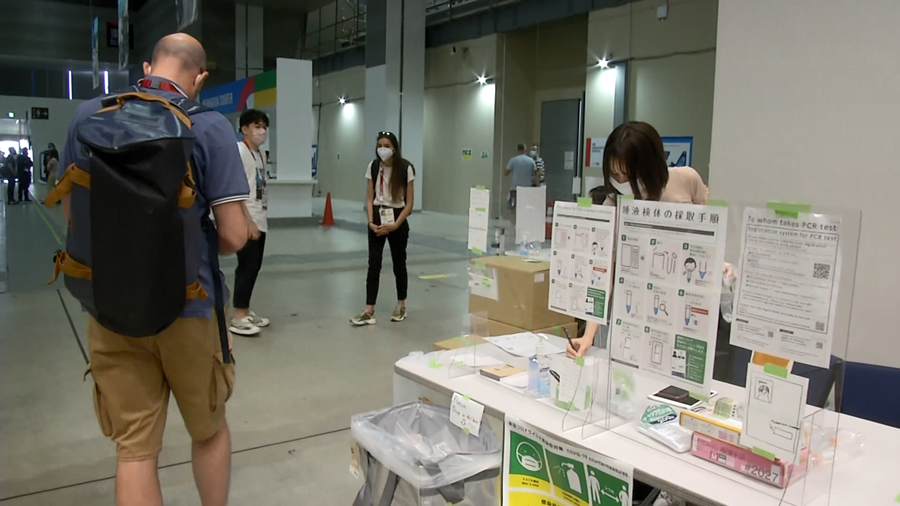
Frequent testing will start upon entry and last for 14 days. For the media, two PCR tests are required before entering Japan. People will be tested once more upon arrival, and then daily for the next three days. After that, there will be one test every four days, and another test once the 14-day mark arrives. That means that within 20 days, people will have to take nine tests. Public health expert Chen Hsiu-hsi says there is usually four days before infected people start exhibiting symptoms. If their infected state can be caught during this time, it can prevent the virus from spreading. If the organizer can test strictly and properly and participants are honest and cooperate, then this frequent testing strategy can, from a scientific point of view, identify infected people in time.
Voice of Chen Hsiu-hsi, Professor, College of Public Health, NTU:" Our calculation is nearly 100 percent because if they test once every three days, they will be able to almost 100 percent intercept it. Vaccines sometimes can't protect against the Delta variant."
Japan has asked participants to strictly comply with all disease prevention regulations and to avert entering into communities. However, Public Television Service reporters in Japan have noted that the drivers of the disease prevention shuttles for foreign media wear masks and are separated by a partition, but don't wear protective goggles or clothing. They have also seen other reporters taking off their masks at the media center while chatting or working with colleagues. The hotel where foreign reporters are staying also has Japanese guests. It may be hard for disease prevention measures to remain watertight despite the strict measures and frequent testing.
桃園國際機場內空蕩蕩,商店幾乎關門大吉,新冠肺炎疫情肆虐以來,民眾入出國、限制重重,人數銳減。當各國仍持續嚴守邊境,日本卻因為舉辦東京奧運,門戶大開,更採泡泡模式,免去參與者14天居家檢疫,到底要怎麼確保疫情可控,日本政府祭出高強度檢測。
「(要做兩次的PCR嗎?) 因為現在疫情期間,所以可能他們政策隨時都在更新,這樣也比較謹慎。(所以是日本,現在應該聽起來,是最嚴的? ) 就他們那邊規定的。」
嚴格檢測,會延續至入境日本後14天,算一算,入境前兩次、入境時要檢、入境後連三天檢、之後媒體記者每四天一檢、滿14天再檢,二十天內檢測高達九次,公衛學者陳秀熙指出,染疫者約有四天左右的症狀前期,若能在此時抓出陽性,就能阻斷病毒傳播,如果主辦方能嚴謹落實檢測,參與者 也能誠實配合、以正確方式採樣,這樣密集的採檢策略,學理上來說,是能及時抓出感染者。
台大公衛所教授 陳秀熙表示:「根據我們算的,幾乎百分之百,因為如果它每三天測一次的話,幾乎是百分之百可以攔截。疫苗有些時候,抵擋不住Delta病毒啦!」
日方也要求參與者嚴格遵守防疫規定、禁止進入社區,不過根據公視記者在東京的觀察,接送外國媒體的防疫專車駕駛,除了隔板口罩,未特別戴護目鏡、穿防護衣,在媒體中心也可見記者脫下口罩,與同業聊天或是工作,而外國媒體下榻的旅館仍有日本人入住。嚴格的防疫措施、密集的採檢,在執行面恐怕難以滴水不漏,這也讓東奧能否安全舉辦、備受考驗。