Interior Minister Worked at Second Chinese University|葉俊榮除了浙大 也掛名中國另一大學


加入公視會員,
按讚收藏你關注的報導
發布時間:
更新時間:
Interior Minister Yeh Jiunn-rong recently admitted he worked as a lecturer at China's Zhejiang University. Now, there are reports that he also taught at Zhongnan University of Economics and Law. Some university presidents commented on the controversial issue of Taiwan scholars lecturing in China, saying that academic exchanges are now frequent between the two sides of the strait, and therefore should not be considered inappropriate or illegal.
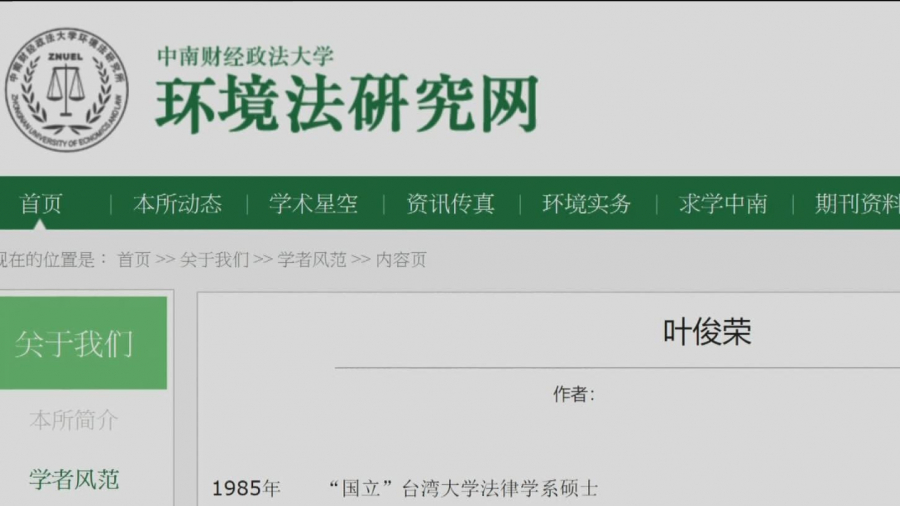
Interior Minister Yeh Jiunn-rong recently admitted he worked as a lecturer at China's Zhejiang University, even though he made sure to emphasize it was a short-term job and not a concurrent job. One day later, reports emerged that he also taught at Zhongnan University of Economics and Law. The school's website had Yeh's resume posted, as well as photos of him giving lectures and participating in forums. Although he wasn't listed as an adjunct professor, it was clear that he was actively involved in school activities. Shih Chien University President Michael Chen, who has taken part in many cross-strait academic exchanges over the years, says listing names doesn't mean anything in China.
We can only say that the rules there aren't very strict. If we look at it from a Taiwan perspective, it's even a bit excessive. If we examine the conditions of Taiwan's university professors working in China and say they are breaking the law by holding concurrent positions, I think it's making a big fuss over a tiny issue.
Chen used his university as an example, saying it has signed many sister university agreements with Chinese universities and there are frequent academic exchanges. Every semester, there are at least 20 student or teacher exchanges to China. Some schools also call adjunct professors as honorary professors, but are not actually violating the Ministry of Education's regulations on part-time work. Chen advises the ministry to explicitly define what part-time work and short-term lecturing are.
Chinese universities sometimes invite our professors to go over there; this is quite frequent and quite common. Now, it appears that everyone is looking at this as illegal behavior, or a sin. I think this is wrong, and you can't handle it like this.
The Taiwan Affairs Office says more efforts should be made to encourage cross-strait academic exchanges, instead of following the Taiwan authorities' strategy of obstructing and limiting exchanges. Scholars say particular places or people should not be targeted when it comes to academic exchanges. They also believe the current attitude of treating everyone like an enemy will not be conducive to future exchanges.