Gov't Takes Part in Floating Marine Debris Survey|12測點採樣 小琉球.曾文溪出海口海漂垃圾多


加入公視會員,
按讚收藏你關注的報導
發布時間:
更新時間:
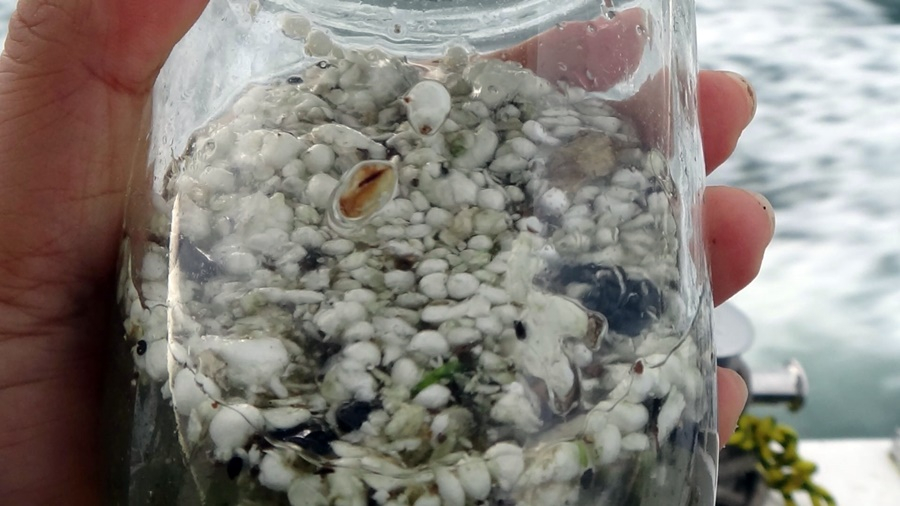
On June 10 and 11, the Ocean Conservation Administration and the Kuroshio Ocean Education Foundation surveyed Taiwan's southwest sea area to learn more about the distribution of microplastics and floating marine debris. They took samples of microplastics from 12 locations and observed the amount of floating marine debris. They discovered the debris was primarily composed of styrofoam, plastics, and plastic bottles.
Researchers have taken ships out to sea and are using nets to collect microplastics on the sea surface. On June 10 and 11, the Ocean Conservation Administration and the Kuroshio Ocean Education Foundation conducted a survey of Taiwan's southwest sea area to learn more about the distribution of microplastics and floating marine debris. The area they surveyed had Liuqiu Island as the southern boundary and the Bazhang River estuary as the northern boundary.
A large amount of the floating marine debris originated from land. This lifestyle habit of throwing trash into the ocean has an effect on our marine environment.
This was the first time that a government agency had taken part in a survey of microplastic pollution in the ocean. During the two days, researchers took samples from 12 locations. They traveled 160 nautical miles, and observed that styrofoam made up a large portion of the floating marine debris.
We saw 66 items during the two days at the sites we observed. In terms of types, there was styrofoam, plastics, and plastic bottles.
The Ocean Conservation Administration intends to continue working with the Kuroshio Ocean Education Foundation to get a better understanding of the trash situation in the waters surrounding Taiwan. It has also commissioned the National Museum of Marine Biology and Aquarium to conduct an investigation on microplastics in marine animals in order to progressively compile information on and establish a system to investigate marine debris.
觀測人員搭船來到海上,用水面拖網在船隻慢慢行駛時撈海面的塑膠微粒,這是為了調查台灣西南海域塑膠微粒以及海漂垃圾的分布狀況,海洋保育署人員與黑潮文教基金會合作,選在6月10號及11號調查,範圍最南到小琉球海域,最北到八掌溪出海口。
海委會海洋保育署副署長 宋欣真表示:「其實海漂垃圾,很多都是從陸源過來的,因此呢,就是我們民眾的生活習慣,其實就會影響到我們海洋的環境。」
這也是第一次有公部門參與海域塑膠微粒的調查,2天的時間內,完成12個觀測點採樣,總共航行160海浬,而觀測到的海漂垃圾,很多都是保麗龍。
海委會海洋保育署副署長 宋欣真表示:「觀測的點,兩天有66件,以這個種類來講呢,其實就是保麗龍,其他的塑膠還有寶特瓶。」
為了逐步掌握全國海域海洋廢棄物現況,海保署除了與黑潮基金會合作,也委託海生館做海洋生物體內微塑膠研究等調查,希望逐步建立海洋廢棄物調查方法與基本資料。